
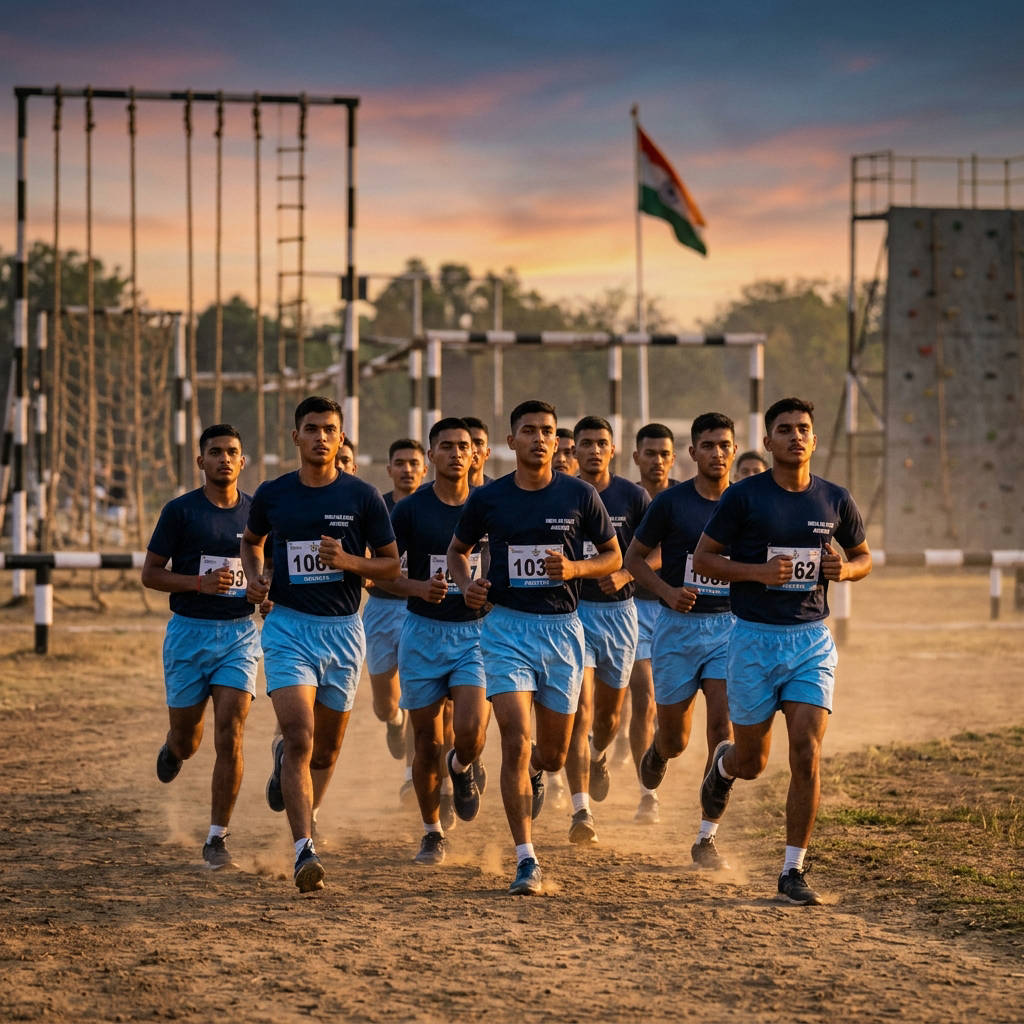
Agniveervayu Physical Fitness Test 2027 – Complete Preparation Guide
Thousands of candidates fail the Indian Air Force recruitment not because of the written exam, but because of the demanding Physical Fitness Test (PFT). A lack of structural guidance, late training starts, and poor fitness forms are the chief reasons candidates fall short at airbase recruitment rallies.
To ensure you are fully prepared to clear your IAF PFT trials, read our complete guide covering official physical benchmarks, stamina tips, strength drills, and training strategies.
📏 Prescribed Physical Standards
Candidates must meet the official height, weight, and general physical standards issued by the Indian Air Force:
- Height Benchmark: Minimum acceptable height is 152.5 cm for male candidates and 152 cm for female candidates.
- Chest Expansion: Minimum range of chest expansion should be 5 cm (applicable to males).
- Weight Parameters: Proportionate to height and age as per IAF medical charts.
🏃 Running Preparation (1.6 km Benchmark)
The core of the PFT is a 1.6 km run to be completed within strict time limits (generally 7 minutes for males and 8 minutes for females). Succeeding requires target training:
- Daily 1.6 km Running: Practice daily runs at a controlled tempo to build dynamic stamina.
- Sprint Interval Training: Perform high-intensity interval sprints (100m/200m) weekly to improve heart capacity and speed.
- Endurance Exercises: Incorporate longer runs (3 km to 5 km) on weekends to build cardiovascular endurance.
- Breathing Techniques: Practice deep rhythmic breathing (inhale for 2 strides, exhale for 2 strides) to prevent side-stitches.
💪 Strength & Conditioning Training
Upon completing the run, candidates must clear push-ups, sit-ups, and squats within 1 minute time frames. Start these workouts:
- Push-ups: Build shoulder, chest, and core stability. Aim for 10-15 correct forms.
- Squats: Strengthen lower body muscles (quadriceps and glutes) for power. Target 20 repetitions.
- Core Exercises: Perform sit-ups and planks daily to strengthen core muscles needed for physical tests.
- Flexibility Training: Always perform full-body static stretching after training to prevent muscle tightening.
⚠️ Common Mistakes to Avoid
- Late Preparation: Starting physical drills only after written exam results are announced is a primary cause of failure. Start training at least 3-4 months in advance.
- Poor Nutrition Diet: Training on an empty stomach or eating junk food hampers muscle recovery. Eat foods rich in proteins and complex carbohydrates.
- Lack of Stamina Training: Only focusing on short running distances without building respiratory capacity.
- Ignoring Body Recovery: Overtraining without allowing muscles rest leading to shin-splints or stress fractures.
🏆 How Droneshwar Defence Academy (DrDA) Helps You
Droneshwar Defence Academy provides Dehradun's premier physical training environment for defence candidates:
- Daily Physical Training: Morning and evening fitness drills conducted on dedicated training grounds.
- Running Ground Practice: Regular timed 1.6 km trials to help you master time management.
- Periodic Fitness Assessments: Body measurements and fitness reports to trace performance progress.
- Expert Mentorship: Direct guidance by experienced ex-defence instructors who instruct you on proper posture and stamina-saving methods.
❓ Frequently Asked Questions
What is the running time for Agniveervayu PFT?
Male candidates must complete the 1.6 km run in 7 minutes, and female candidates have 8 minutes.
Are push-ups required in the Air Force Agniveer physical test?
Yes, candidates must perform 10 push-ups, 10 sit-ups, and 20 squats within 1 minute each to qualify.
How can I join the best physical academy for Agniveer in Dehradun?
You can enroll at Droneshwar Defence Academy (DrDA). We provide complete written exam prep combined with daily physical workouts under decorated mentors.
📍 Contact Droneshwar Defence Academy (DrDA)
📞 7878553385 | 6399000440
📍 3rd Floor, Om Tower, Sahastradhara Road, Near IT Park, Dehradun, Uttarakhand
🌐 DRONESHWARDEFENCEACADEMY.COM
✈ NDA | CDS | SSB | Agniveer | Army | Navy | Air Force